A 10-story student housing project near the Chesapeake Greenbrier corridor faced a familiar problem: the top 30 feet of soil were soft estuarine clay underlain by dense sand. Without reliable shear strength parameters, the foundation design would default to conservative—and expensive—piled solutions. Running a triaxial test on undisturbed samples from that clay layer allowed the geotechnical team to use the undrained shear strength (Su) for short-term stability and the effective friction angle (φ') for long-term drained conditions. This directly reduced the number of required piles. In Chesapeake, where groundwater sits only 4 to 6 feet below grade, the combination of a consolidation test for settlement estimates and the triaxial test for strength gives engineers a complete picture before any concrete is poured.
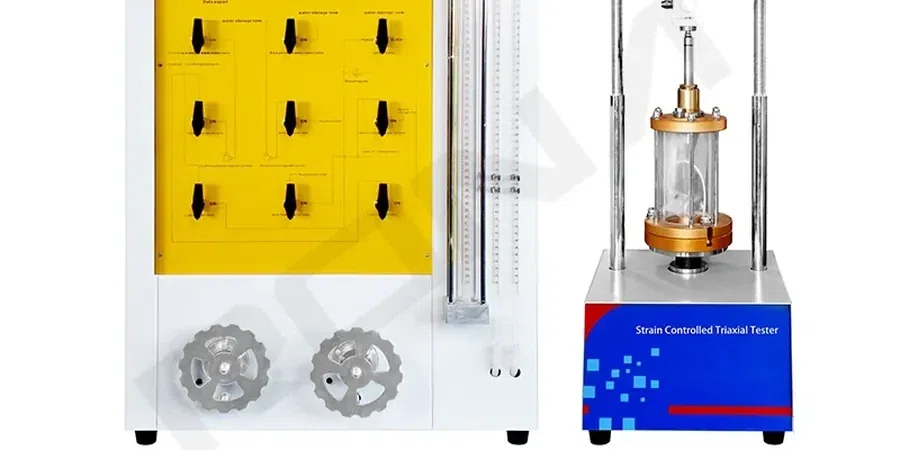
A single triaxial test on undisturbed clay can cut foundation costs by 15–20% when the design shifts from empirical rules to measured shear strength.
Approach and scope
- UU triaxial: quick results (24–48 hours) for immediate bearing capacity
- CU triaxial with pore pressure measurement: effective stress parameters for slope stability and retaining walls
- CD triaxial: full drained strength for long-term foundation loading
Site-specific factors
Chesapeake sits on the Atlantic Coastal Plain, underlain by thick sequences of the Yorktown and St. Marys formations. These units contain interbedded clay, silt, and sand layers with abrupt lateral changes. A triaxial test performed on a Shelby tube sample from one borehole may show Su = 40 kPa, while a sample taken 50 feet away in the same unit could yield Su = 80 kPa. That variability is real—it reflects lenses of shell hash or silt that alter drainage paths. Ignoring that spread and using a single average value for design can lead to differential settlements exceeding 2 inches in a building. The risk is not in the test itself but in assuming that three specimens represent the whole site. Good practice in Chesapeake requires at least one triaxial test per distinct soil layer per building footprint, supplemented by Cone Penetration Testing for continuous profiling between boreholes.
Service video
Relevant standards
ASTM D2850-15 (UU triaxial on cohesive soils), ASTM D4767-11 (CU triaxial with pore pressure measurement), ASTM D7181-11 (CD triaxial on granular soils)
Related technical services
Multi-Stage Triaxial
A single specimen is tested at three increasing confining pressures, reducing the number of samples needed while still yielding a Mohr-Coulomb failure envelope. Ideal for thin clay layers where undisturbed sample recovery is limited.
Triaxial with Bender Elements
Piezoelectric bender elements embedded in the end caps measure shear wave velocity (Vs) during consolidation, giving the small-strain shear modulus (Gmax) alongside the standard strength parameters. Useful for seismic site response in Chesapeake's moderate seismicity zone.
K0 Consolidated Triaxial
The specimen is consolidated under zero lateral strain (K0 condition) before shearing, mimicking the stress path of a foundation load more accurately than isotropic consolidation. Essential for settlement analysis of mat foundations on the soft clays found near the Intracoastal Waterway.
Typical parameters
FAQ
How many triaxial test specimens are needed for a typical Chesapeake commercial building?
For a mid-rise building (4–8 stories), the geotechnical engineer usually requires one triaxial test per major soil layer per foundation zone. That typically means 3 to 6 tests: one UU for the surficial clay, one CU for the deeper clay, and one CD for the bearing sand layer. Each test uses 3 specimens at different confining stresses.
What is the difference between UU, CU, and CD triaxial tests?
UU (unconsolidated-undrained) applies load without allowing drainage—fast, used for short-term stability in clay. CU (consolidated-undrained) lets the sample drain under confining stress before shearing, measuring pore pressure during shear to get effective stress parameters. CD (consolidated-drained) allows full drainage during shear, giving the true drained friction angle for long-term loading. Each serves a different design scenario.
How long does a triaxial test take in the Chesapeake lab?
A UU test can be completed in 2–3 days. A CU test with pore pressure measurements takes 5–7 days because consolidation requires time. A CD test on sand can take 7–10 days. The lab in Chesapeake prioritizes projects with tight deadlines and can expedite UU tests to 24 hours if notified in advance.
Can triaxial test results be used for seismic site classification in Chesapeake?
The small-strain shear modulus (Gmax) from bender-element-equipped triaxial tests can help define the site class per ASCE 7, but the primary method for site classification in Chesapeake is Vs30 from surface wave testing. The triaxial test provides complementary data for site-specific response analysis, especially when combined with cyclic triaxial testing for liquefaction assessment.
How much does a triaxial test cost in Chesapeake?
The typical cost for a standard UU triaxial test (3 specimens) ranges from US$2.150 to US$2.840, depending on the number of specimens and whether pore pressure measurements are included. CU and CD tests cost more due to longer setup and monitoring time. The lab provides a firm quote after reviewing the sample quality and test requirements.