For pavement projects in Chesapeake, ASTM D1883 governs the laboratory California Bearing Ratio test. This standard determines the strength of subgrade, subbase, and base materials. Chesapeake's location in the Mid-Atlantic Coastal Plain means sandy and silty soils with a high water table are common. These conditions directly affect pavement performance. A reliable CBR value is essential for designing flexible pavements that withstand local traffic loads and seasonal moisture changes. Before placing any asphalt or concrete, we run the soaked CBR test to simulate worst-case saturation scenarios. The result helps engineers set layer thicknesses and select appropriate materials. Complement this analysis with a geotechnical study of soils to map subsurface variability across the project site.
A soaked CBR value below 5% in Chesapeake's coastal soils signals the need for subgrade stabilization or a thicker pavement section.
Approach and scope
Site-specific factors
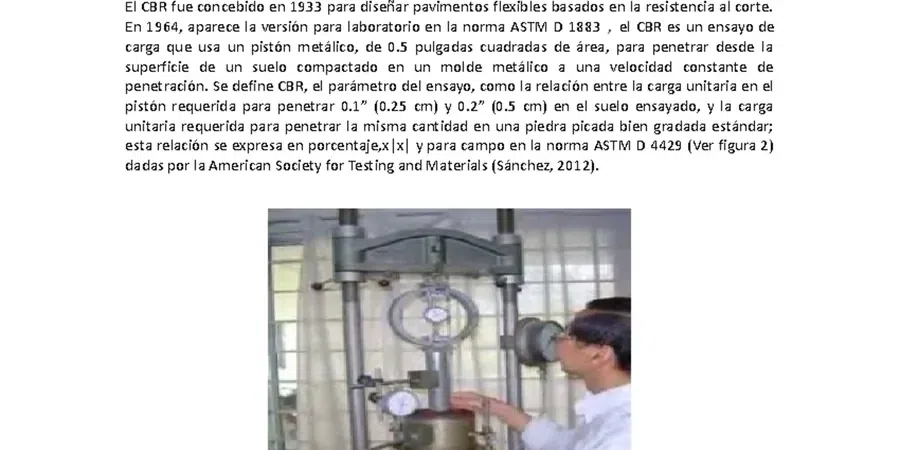
Our lab technician places the compacted sample in a sturdy steel mold with a surcharge weight, submerges it in a water bath, and lets it sit for four days. After soaking, the sample is removed and placed under a calibrated proving ring. A piston pushes into the soil at a constant rate. The load required to penetrate 2.5 mm and 5.0 mm is recorded. In Chesapeake, the biggest risk is underestimating moisture damage. If the soaked CBR comes back below 5%, the pavement will likely fail within a few years. We flag those results immediately and suggest corrective measures like lime stabilization or increased base thickness.
Relevant standards
ASTM D1883-21 – Standard Test Method for California Bearing Ratio (CBR) of Laboratory-Compacted Soils, ASTM D698-12 – Standard Test Methods for Laboratory Compaction Characteristics of Soil Using Standard Effort, AASHTO T193-13 – The California Bearing Ratio
Related technical services
Standard Laboratory CBR Test
Full ASTM D1883 test on undisturbed or remolded samples. Includes compaction, 4-day soak, and penetration curve. Results within 7 business days.
Unsoaked California Bearing Ratio Test
Same test procedure without the 96-hour soak. Used for preliminary screening or when moisture conditions are well controlled on site. Faster turnaround.
Typical parameters
FAQ
What does a laboratory CBR test measure?
It measures the bearing capacity of a compacted soil sample under controlled moisture and density conditions. The result is a percentage that compares the soil's resistance to a standard crushed rock. Engineers use this value to design pavement thickness.
How long does a laboratory CBR test take?
The entire process, including compaction, 4-day soaking, and penetration testing, takes about one week. Unsoaked tests can be completed in 2–3 days. We provide preliminary CBR values upon request.
What CBR value is typical for soils in Chesapeake?
Most natural subgrades in Chesapeake fall between 3% and 12%. Sandy soils near the coast tend to score higher, while clayey fills and organic deposits can drop below 5%. Each project is unique.
How much does a laboratory CBR test cost in Chesapeake?
The typical range is US$120 – US$200 per sample. Volume discounts apply for multiple samples from the same project. Contact us for a quote tailored to your scope.
Can you run a CBR test on disturbed samples?
Yes. The test is performed on remolded samples compacted in the lab. We can also test intact tube samples if you provide them. Either way, the result reflects the material's potential performance under compaction.