Chesapeake sits on the Atlantic Coastal Plain where the water table sits 3 to 8 feet below grade. That shallow groundwater, combined with interbedded sands and clays of the Yorktown and Tabb formations, makes foundation design a challenge. We approach micropile design here by first running our dilatometer tests to measure in-situ lateral stress and stiffness, then correlating those data with local SPT blow counts. Grouted micropiles 7 to 12 inches in diameter are typical for this region, with bond zones placed in the dense sands below 40 feet to mobilize skin friction before the clay layers creep.
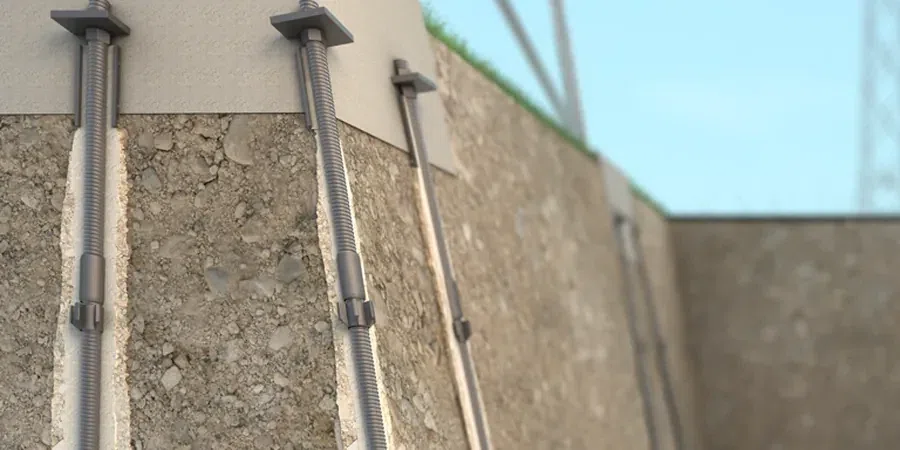
Grouted micropiles 7 to 12 inches in diameter are typical for Chesapeake, with bond zones placed in the dense sands below 40 feet.
Approach and scope
Site-specific factors
In Chesapeake we often see that the clay layers between 15 and 25 feet are soft to medium stiff, with undrained shear strengths around 0.3 to 0.6 ksf. If the micropile bond zone inadvertently terminates in that horizon instead of reaching the underlying dense sand, the pile settlement doubles. We flag this risk early by running a continuous soil profile with a presurometro probe on every third boring, which gives us the lateral modulus needed to check downdrag from the soft clay. Skipping that step can lead to a pile that meets the axial load test but settles 1.5 inches over time, cracking the supported column.
Relevant standards
IBC 2021 Section 1810.3.2 – Micropile design and installation, ASCE 7-22 Section 12.13 – Seismic load effects on deep foundations, FHWA-SA-97-070 – Micropile design and construction guidelines, ASTM D1143 – Static axial compressive load test for deep foundations
Related technical services
Proof load testing per ASTM D1143
We instrument each test pile with vibrating-wire strain gauges and dial gauges at the head. Load is applied in 25% increments up to 200% of the design load, held for 30 minutes, then unloaded in four steps. The load-settlement curve is plotted and compared to the Davisson offset limit to confirm the geotechnical bond capacity.
Grout take estimation and bond-zone modeling
Using the soil profile from the presurometer and SPT logs, we estimate the grout take per linear foot of bond zone. We model the grout bulb shape in layered sands and clays with a finite-difference code, then back-calculate the mobilized side shear from the test data to refine the design for production piles.
Typical parameters
FAQ
What is the typical depth for micropile bond zones in Chesapeake?
Bond zones are usually placed 40 to 55 feet below grade, targeting the dense sand layers of the Tabb formation. The exact depth is adjusted based on SPT blow counts (N-value > 30) and the presurometer modulus profile. Avoid placing the bond zone in the soft clay between 15 and 25 feet.
How do you verify the axial capacity of a micropile in Chesapeake?
We run a static compression test per ASTM D1143 on at least 2% of production piles. The load is taken to 200% of the design load, and the acceptance criterion is the Davisson offset limit (0.15 in + D/120). If the pile passes, the bond-zone design is validated for the rest of the site.
What grout mix is recommended for micropiles in saturated sands?
We use a neat cement grout with a water-cement ratio of 0.45 to 0.50, a 28-day compressive strength of 5,000 psi minimum, and a Marsh cone flow time of 35 to 40 seconds. For the first stage, we add a non-shrink admixture to prevent voids under the water table. The grout is placed by tremie from the bottom up.
Can micropiles be designed to resist lateral loads in Chesapeake?
Yes, but the lateral capacity is limited by the soft clay layers. We evaluate lateral behavior using the p-y curve method from the FHWA-SA-97-070 manual. For piles spaced closer than 3 diameters, we reduce the lateral resistance by 30% to account for group shadowing. A lateral load test per ASTM D3966 is recommended if the design lateral exceeds 15 kip per pile.
What is the typical cost range for micropile design and installation in Chesapeake?
The range for design, load testing, and installation in Chesapeake is US$1,450 to US$5,180 per pile, depending on depth, grout volume, and access constraints. The cost covers the SPT boring, presurometer test, grout mix design, proof load test, and engineering report.