A six-story apartment building going up near the Chesapeake Square Mall needed foundation capacities beyond what standard SPT data could provide. The sandy soils there, mixed with occasional clay layers, behave differently under lateral load. That’s exactly when we deploy the Ménard pressuremeter test in Chesapeake. Instead of relying on empirical correlations, we get direct measurements of the soil’s modulus (E_M), limit pressure (p_L), and creep pressure (p_f). This data feeds directly into settlement calculations and bearing capacity estimates. For projects where the risk is high and the loads are non-uniform, skipping the PMT means guessing. We don’t guess. We measure. The pressuremeter is also a great complement to a plate load test when you need deeper profiling without excavating large pits.
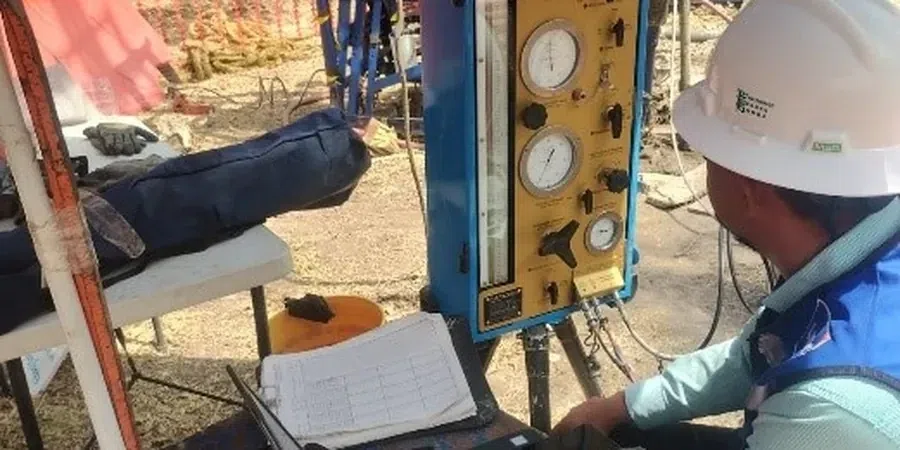
Direct measurement of soil modulus (E_M) and limit pressure (p_L) replaces empirical guesswork — essential for deep foundations and settlement-sensitive structures in Chesapeake’s variable soils.
Approach and scope
Site-specific factors
A common mistake we see in Chesapeake is relying solely on SPT N-values to estimate settlement for shallow footings on silty sand. Those correlations were developed for clean sands, not the mixed soils of the region. One contractor assumed a bearing capacity of 3,500 psf based on standard tables, but the PMT later showed the actual limit pressure was 30% lower. That mismatch would have led to differential settlement of over an inch. We always recommend running the Ménard pressuremeter test in Chesapeake when the soil profile includes transitional layers or when the structure is sensitive to movement. It catches the weak spots before they become claims.
Relevant standards
ASTM D4719-20 (Standard Test Method for Prebored Pressuremeter Testing in Soils), IBC 2024 (Section 1806 – Presumptive Load-Bearing Values), ASCE 7-22 (Minimum Design Loads for Buildings and Other Structures), FHWA NHI-05-037 (Manual on Subsurface Investigations – Pressuremeter Section)
Related technical services
Prebored PMT – Standard Depth Profiling
We drill NX-size boreholes and run the Ménard probe at 1 m intervals. Suitable for most soil types except gravels and hard rock. Output includes E_M, p_L, p_f, and pressure-volume curves per ASTM D4719.
Self-Boring Pressuremeter (SBPMT)
For soft clays and very loose sands where borehole disturbance is critical. The self-boring probe advances with minimal soil disturbance, giving the most accurate modulus values for settlement analysis.
Pressuremeter Data Interpretation & Design Report
We convert raw pressure-volume data into design-ready parameters: bearing capacity, settlement modulus, lateral earth pressure coefficient (K_0), and p-y curves for laterally loaded piles.
Typical parameters
FAQ
How is the Ménard pressuremeter test different from an SPT in Chesapeake soils?
The SPT measures resistance to dynamic driving, which is good for relative density but poor for modulus. The PMT directly measures soil stiffness under controlled radial expansion. In Chesapeake's mixed silty sands, the PMT gives a true E_M value for settlement analysis, while SPT correlations can be off by 40%.
What is the typical cost range for a Ménard pressuremeter test in Chesapeake?
The cost for a PMT in Chesapeake typically ranges between US$950 and US$1,420 per test point, depending on depth, access conditions, and number of tests. Volume discounts apply for multi-point programs. This includes drilling, probe calibration, and a full data report.
Can the pressuremeter test be used for laterally loaded pile design?
Yes. The PMT provides p-y curves directly, which are the standard input for laterally loaded pile analysis. The limit pressure (p_L) correlates well with ultimate lateral resistance, and the modulus (E_M) governs the initial stiffness. It is widely used for deep foundations in Chesapeake.
What soil conditions in Chesapeake require a pressuremeter test instead of a plate load test?
Plate load tests only measure the top 1-2 diameters of influence. For deeper foundation elements like piles or drilled shafts, the PMT profiles the entire length. In Chesapeake, where soft layers can be buried under 15 feet of stiff sand, the PMT catches those weak zones that a surface plate would miss.
How deep can the Ménard pressuremeter probe reach in Chesapeake?
We routinely test down to 100 feet (30 m) using standard NX-size drill rods. For deeper requirements, we can extend to 150 feet with specialized tooling. The depth limit is primarily the borehole stability and the capacity of the drill rig.