The Virginia building code adopts the IBC with amendments, and Chesapeake sits on the clay-rich Coastal Plain. We follow ASTM D4318 for Atterberg limits and ASTM D4546 for swell pressure. This matters because the shrink-swell cycles here crack slabs and lift foundations every summer. A proper expansive soil evaluation in Chesapeake starts with index testing and ends with a swell-consolidation curve. We correlate that data to the local plasticity chart and deliver a report your structural engineer can use directly. Complement the index work with a georradar survey to map subsurface voids, and run a consolidation test to estimate heave magnitude under load.
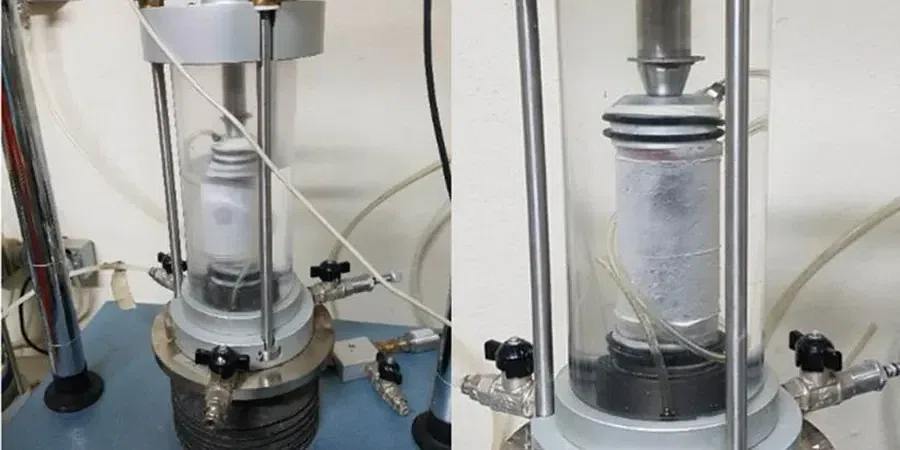
Chesapeake clay can swell up to 6% vertical strain. Our index-based method catches that before the foundation is poured.
Approach and scope
Site-specific factors
The Yorktown Formation under Chesapeake contains smectite clays that change volume with every wet-dry cycle. In the Great Dismal Swamp fringe, organic content amplifies the shrinkage. A foundation poured on untreated clay can experience differential movement exceeding 2 inches within two years. Our expansive soil evaluation in Chesapeake quantifies that risk by testing undisturbed ring samples at natural water content. We run three cycles of wetting and drying to simulate seasonal extremes. The data feeds directly into slab-on-grade design per IBC Section 1805. Ignoring this step leads to cracked drywall, tilted porches, and stuck doors — repairs that cost far more than the lab work.
Relevant standards
ASTM D4318-17e1 – Atterberg Limits, ASTM D4546-21 – One-Dimensional Swell/Collapse, ASTM D4829-19 – Expansion Potential Index, IBC 2021 Section 1805 – Foundation Design for Expansive Soils, Virginia Uniform Statewide Building Code (USBC) 2021 amendments
Related technical services
Standard Swell Test Package
Includes Atterberg limits, natural moisture content, and one-dimensional free swell under 1 psi seating load. Results in 7 working days. Suitable for residential slabs and light commercial.
Advanced Heave Analysis
Adds constant-volume swell pressure, cyclic wet-dry testing, and active-zone depth determination. Includes suction measurement (filter paper method) for unsaturated analysis. Recommended for schools, hospitals, and multi-story structures.
Typical parameters
FAQ
How deep does the active clay layer extend in Chesapeake?
Typical active zone depth ranges from 1.5 to 3.0 meters in the Yorktown and Bacons Castle formations. We determine the exact depth using moisture content profiles and suction measurements.
What does an expansive soil evaluation cost in Chesapeake?
The standard package runs between US$590 and US$1,590 depending on the number of samples and test type. The advanced heave analysis with cyclic testing is typically US$1,200 to US$2,400.
Can I build a slab-on-grade on high-PI clay in Chesapeake?
Yes, but only after a proper evaluation. IBC Section 1805 requires either removal/replacement of the active clay, moisture control, or a structural slab designed for heave. Our report gives you the swell pressure and expected movement to size the reinforcement.
Do you test for sulfates in the clay before recommending lime stabilization?
Yes. Pyritic clays common in the Tidewater region can cause ettringite formation and secondary heave if treated with calcium-based stabilizers. We run ASTM C1580 sulfate analysis before any stabilization design.