The clayey soils near the Elizabeth River behave nothing like the sandy loam found around the Great Dismal Swamp. That wide variation is exactly why a localized CBR study for road design in Chesapeake is non-negotiable. We have tested subgrades in the Greenbrier business district where the CBR came in at 2.5%, and on the high ground near Oak Grove where it reached 12%. Before any pavement section is calculated, we run soaked and unsoaked CBR tests on undisturbed samples. For projects on very soft ground, we often pair this with a geotechnical study for roads to evaluate the full soil profile down to firm strata. The difference between a correct pavement design and a guess is measured in years of service life.
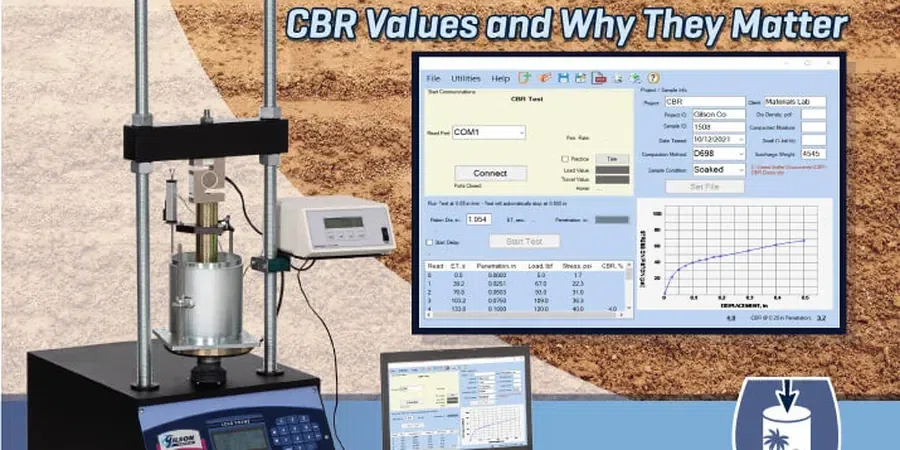
In Chesapeake, soaked CBR can drop to half of the unsoaked value when water table is close to the surface.
Approach and scope
Site-specific factors
Pavement design in Chesapeake must comply with the Virginia Department of Transportation (VDOT) Road and Bridge Standards, which require site-specific CBR values for all new subdivisions and commercial access roads. If the subgrade strength is overestimated by even 2 percentage points, the pavement section will be too thin. The result is premature cracking, rutting, and failure within three to five years. We have seen parking lots in the Battlefield area fail within two winters because the designer used a generic CBR of 6% when the actual soaked value was 3.5%. That mistake costs the owner tens of thousands in full-depth reclamation. Our CBR study for road design in Chesapeake eliminates that risk.
Service video
Relevant standards
ASTM D1883-16: Standard Test Method for CBR of Laboratory-Compacted Soils, AASHTO T-193: The California Bearing Ratio, VDOT Road and Bridge Standards (Section 300: Subgrade and Base), AASHTO Guide for Design of Pavement Structures 1993
Related technical services
Soaked and Unsoaked CBR Testing
Laboratory compaction at standard or modified Proctor energy, followed by four-day soaking. We measure both the bearing ratio and the free swell. Results are delivered with the penetration curve and corrected load values.
In-Situ CBR with DCP
For existing subgrades or compacted fills, we use the Dynamic Cone Penetrometer (DCP) to estimate CBR in the field. This method correlates penetration per blow to bearing capacity. Useful for quality control during earthwork in Chesapeake.
Pavement Section Design Support
Based on the CBR value, traffic load (ESALs), and VDOT requirements, we recommend asphalt or concrete thickness. We produce a design memo with the structural number and layer coefficients for the project.
Typical parameters
FAQ
How long does a CBR study for road design in Chesapeake take?
The full laboratory cycle takes five to seven business days. The soil sample must be compacted, cured if needed, and soaked for 96 hours. The penetration test itself takes about 30 minutes per sample. We can expedite the process for urgent projects if the sample arrives early in the week.
What is the difference between soaked and unsoaked CBR, and which one should I use?
The soaked CBR simulates the worst-case condition after the subgrade has been saturated by rain or groundwater. The unsoaked value represents the strength at optimum moisture content. For pavement design in Chesapeake, VDOT requires the soaked CBR unless the pavement is fully impermeable and drained year-round. Use the soaked value for thickness calculations.
Do you perform CBR testing on site or only in the laboratory?
We do both. The laboratory CBR (ASTM D1883) is the standard for design. But we also run in-situ tests using a Dynamic Cone Penetrometer (DCP) during construction to verify that the compacted subgrade meets the design CBR. The DCP gives a quick CBR estimate every 10 cm of depth.
How much does a CBR study cost in Chesapeake?
The cost for a standard laboratory CBR test with one compaction point and soaking ranges between US$170 and US$330 per sample. Additional points for different moisture contents increase the price. The final quote depends on the number of samples and whether you need a full pavement design report.