In Chesapeake, we see it time and again: a slab cracks, a wall tilts, and the owner is left wondering why. The culprit is almost always differential settlement, not total settlement. The city's varied geology — from marine terraces to deep clay deposits near the Elizabeth River — creates pockets of compressible soil that behave differently under load. We measure that variability directly. Before pouring any foundation, we run a full profile of the subsurface, correlating soil stiffness with depth to identify where differential movement will occur. Pairing this with a consolidation test gives us the settlement rate, while a borehole SPT tells us the strength profile at every foot. That data lets us design foundations that tolerate or eliminate the uneven movement before it starts.
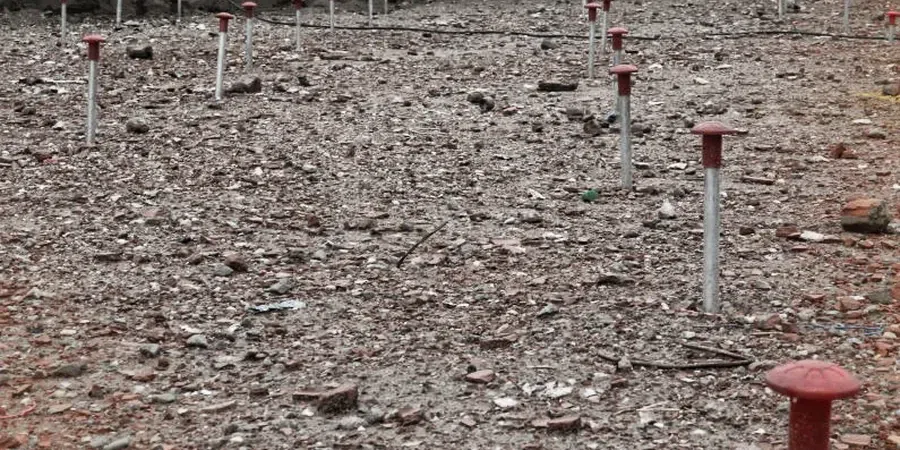
Differential settlement in Chesapeake is driven by thin clay lenses at shallow depth. One boring is rarely enough to catch them.
Approach and scope
Site-specific factors
The biggest risk in Chesapeake comes from the shallow water table combined with seasonal drought. When the water table drops, the clay layers shrink; when it rises, they swell. That cyclic movement causes cumulative differential settlement that a single wet season won't reveal. We've seen slabs that looked fine in spring crack by August. Add the region's hurricane-driven storm surge — like the one that pushed water levels 6 feet above normal during Isabel in 2003 — and you get rapid soil saturation that triggers consolidation under existing loads. Any analysis that ignores this seasonal moisture cycle underestimates the real movement by a factor of two or more.
Relevant standards
ASTM D2435 (Standard Test Method for One-Dimensional Consolidation), ASTM D4546 (Swelling and Collapse of Soils), IBC 2021 Chapter 18 (Soils and Foundations), ASCE 7-22 Minimum Design Loads (settlement criteria)
Related technical services
Subsurface Investigation & Soil Sampling
Boreholes to 40 feet with SPT and undisturbed tube sampling. We log each strata and collect samples for consolidation testing. Field work follows ASTM D1586 and ASTM D2488.
Consolidation & Settlement Modeling
One-dimensional consolidation tests (ASTM D2435) to determine Cc, Cr, and preconsolidation pressure. We run settlement calculations under each footing and column, identifying differential zones.
Foundation Design Recommendations
Based on the settlement profile, we recommend foundation type, depth, and reinforcement. Options range from thickened slabs on improved ground to deep foundations where differential movement exceeds tolerable limits.
Typical parameters
FAQ
What causes differential settlement in Chesapeake homes?
Most cases trace back to shallow clay lenses that are thicker under one corner of the house than another. When those clays consolidate under the building load — or when they shrink and swell with seasonal moisture changes — the foundation moves unevenly. Tree roots removing water from one side of the slab can also trigger significant differential movement within a single summer.
How much does a differential settlement analysis cost in Chesapeake?
For a typical single-family home lot, expect between US$830 and US$1,820 depending on the number of borings and lab tests required. That range covers two boreholes to 25-30 feet, consolidation tests on the clay layers, and a full settlement prediction report with foundation recommendations.
What tolerable differential movement does IBC allow?
IBC 2021 Table 1604.3 sets a default limit of 1/300 of the span for structural frames and 1/360 for brittle finishes like tile or stucco. For a 20-foot bay, that means no more than 0.8 inches of differential movement. We always check against the specific finish materials — a difference of 0.1 inches can mean cracked tile versus intact floors.
How many borings are needed for a differential settlement study?
At least two — one at each end of the structure — to capture the variation across the site. For longer buildings or those on variable fill, we recommend one boring every 40 to 50 feet. A single boring tells you the soil profile at one point; it cannot detect the clay lens that exists only under the garage slab.