The subsurface of Chesapeake is dominated by Quaternary fluvial and marine deposits, with silty sands (SM) and low-plasticity clays (CL) extending 10 to 25 feet before reaching the Yorktown Formation. These materials are notoriously sensitive to water content during compaction. We perform the Proctor test — both Standard (ASTM D698) and Modified (ASTM D1557) — to define the optimum moisture content and maximum dry density for every soil type encountered in Chesapeake. Before we run the Proctor, we classify the material through a granulometry analysis to confirm the grain-size distribution and ensure the correct compaction method is selected. The results guide compaction specifications for everything from residential subdivisions to large commercial pads in the Greenbrier area.
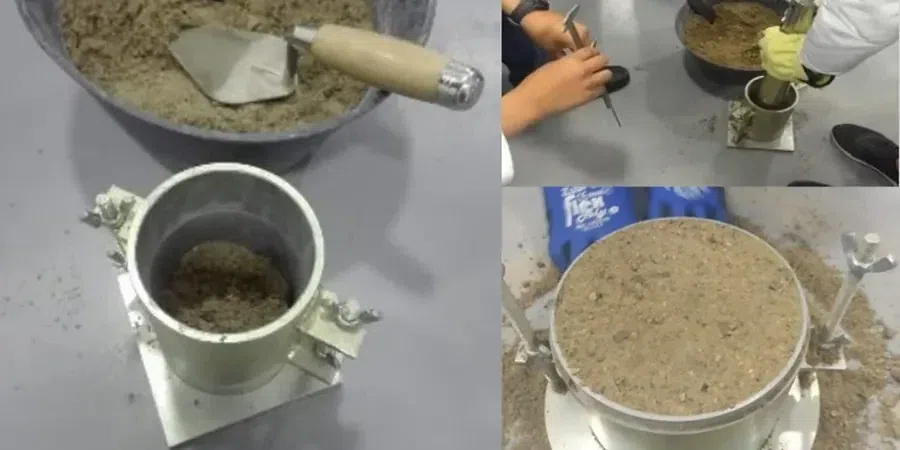
For silty sands in Chesapeake, a 2% deviation from OMC can reduce dry density by 8 to 10 pcf, triggering rework costs.
Approach and scope
- We split samples into Standard (for light compaction, < 56,000 ft-lbf/ft³) and Modified (for heavy roller compaction, > 56,000 ft-lbf/ft³) based on the project specifications.
- Each test produces a four- to five-point compaction curve; we routinely run duplicate curves when the soil has more than 15% fines.
- The lab reports both optimum moisture content (OMC) and maximum dry density (MDD), plus the zero-air-voids curve for reference.
Site-specific factors
A Proctor test that is run on a non-representative sample is worse than no test at all. In Chesapeake, where the water table sits within 6 to 10 feet of the surface in many lots near the Elizabeth River, the in-situ moisture content is often above OMC. If the lab uses a dried sample that doesn't match field conditions, the compaction curve will mislead the contractor. We always request a minimum of 25 pounds of material per test and verify the field moisture before starting. Our lab holds ISO 17025 accreditation, and every Proctor curve is reviewed by a senior technician before release.
Service video
Relevant standards
ASTM D698-12 (Standard Proctor), ASTM D1557-12 (Modified Proctor), AASHTO T-99 / T-180, IBC 2021 Chapter 18
Related technical services
Standard Proctor (ASTM D698)
For light to moderate compaction control on residential fills, utility trenches, and low-volume roads. Includes full moisture-density curve and OMC/MDD report.
Modified Proctor (ASTM D1557)
Required for high-traffic pavements, structural backfill, and heavy embankments. Higher compactive effort simulates modern rollers and vibratory equipment.
Proctor with CBR Correlation
We run the Proctor test followed by soaked CBR at OMC to provide pavement design parameters in a single workflow. Common for VDOT and local municipal projects.
Typical parameters
FAQ
What is the difference between Standard and Modified Proctor tests?
The difference is the compactive energy applied. Standard Proctor (ASTM D698) uses a 5.5 lb hammer dropped 12 inches with 25 blows per layer, for 12,400 ft-lbf/ft³. Modified Proctor (ASTM D1557) uses a 10 lb hammer dropped 18 inches with 25 blows per layer, for 56,000 ft-lbf/ft³. Modified is used for deeper fills and heavy traffic areas; Standard is typical for residential and light commercial work.
How much does a Proctor test cost in Chesapeake?
The typical range for a single Proctor test in Chesapeake is between $100 and $230, depending on whether it is Standard or Modified and whether a duplicate curve is needed. Volume discounts apply for projects with multiple samples.
How much soil sample is needed for a Proctor test?
We require a minimum of 25 pounds of bulk soil for a Standard Proctor test and 35 pounds for a Modified test. The sample must be representative of the fill material that will be placed on site. If the material contains gravel larger than 3/4 inch, we may need additional material or request an oversized correction.
Can you run Proctor tests on soils with high moisture content from the field?
Yes. If the field moisture is above OMC, we can air-dry the sample in the lab to reach the target range before testing. We always report the starting moisture content so the contractor knows how much drying is needed. For Chesapeake's typical silty sands, we often start 3 to 5 points below OMC and work upward.